
My friend Frank: “Hey, Frank give me $20”.
Me: “Why?”
“I want to put it on 27.”
“C’mon, we are late meeting the guys and we haven’t even checked in.”
“I know, just give me 20 bucks. I’ll pay you back. I only have hundreds.”
“We’re late and you’d just be throwing away 20 dollars that I’ll never see again.”
“No, I’ll pay you back; I just got a feeling…”
I am not a great gambler. In fact, I’m kind of bad at it. Probably because I’m inherently cheap and I can’t stand the thought of throwing my hard-earned money away in a situation that I know is statistically stacked against me.
My first real exposure to gambling came as a result of the legalization of Off Track Horse Betting in New York in the early 70s. One day during my senior year of high school walking through the Sunrise Mall, my friends and I happened upon an austere storefront emblazoned with a sign that read simply “OTB”. We had to investigate. It was a wild world inside. TVs lined up along the walls, tables overflowing with newspapers and scraps of paper, and men (only men) smoking cigarettes and cigars milling about. What the heck!? Slow but not necessarily stupid, we figured it out and decided to make a few bets. Being the conservative type, I placed a $2 bet on Tom Topper (yes, I remember his name) to ‘Place’ (come in first or second). His early line odds were 4-1, not the favorite, but also not a longshot. The next morning, I was eager to check the paper and…the darned thing won the race. After school, we drove down to the mall to collect my winnings and I invested my original $2 on another horse; this time the favorite to ‘Win’. I don’t recall his name, but… the darned thing won the race. I do recall being very disappointed with the payout (something like $2.60 on a $2 bet…what’s the point?!), so I screwed up the courage to bet on a horse set to go off at 10-1 odds. (Yes, this was the extent of my analysis…picking horses based on names and odds). Now, I’m still a weeny so I wussed out and bet on him to ‘Show’ (first, second, or THIRD) and… the darned thing won the race! Even my weak Show bet paid about $6. Three bets; three (squirrelly) wins. That’s a recipe for disaster.
Now I had to learn more about this world of horse racing, of which I was basically oblivious. There are 3 Racetracks on Long Island: Aqueduct Raceway and Belmont Park host Thoroughbreds while Roosevelt Raceway features Harness Racing. Roosevelt has since closed but it was the closest and had evening racing. Road trip! 8 of us made that first trek to investigate the over- and under- belly of horse racing. We arrived wide-eyed, amazed, excited and dumbfounded that this entire world of action was hidden from our suburban eyes until now.
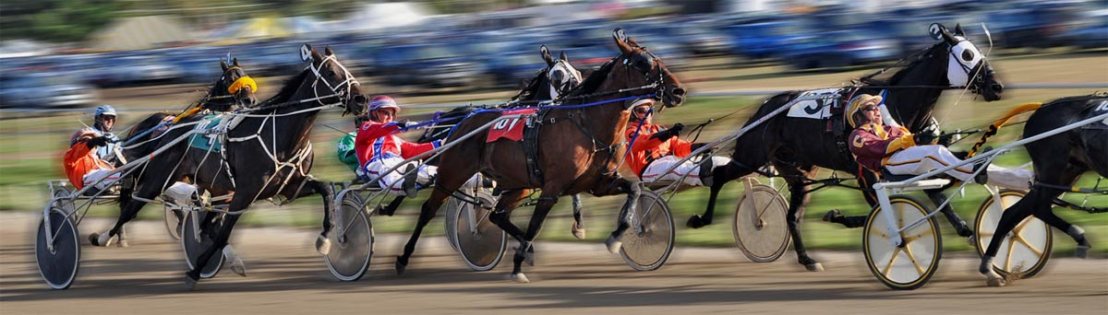 The horses were huge; the contraptions they pulled were engineering marvels, the tote board was information overload, the stands were filled, the restaurants, the action, the screaming, the characters, the sounds. WOW! Of course, it wasn’t all pretty; there were definitely people there who needed help. More than a few looked homeless but they apparently scraped up betting money which they absolutely couldn’t afford to lose.
Anyway, we learned to read the Daily Racing Form and made more informed bets, but we never deluded ourselves into thinking we could figure it out. It all does sound mathematically elegant: Odds are determined by the percent of total money bet on each horse (lots of money on a horse drives down the odds) so that the track pays out the same amount regardless of which horse wins. Still, one just cannot escape the feeling that some way, somehow, the game is fixed. Heck, in harness racing it even looks like some horses in the lead are purposely being slowed by the drivers! In the end, though, I rationalized that even if it was fixed, it wasn’t fixed specifically against ME, so I just had to be lucky. That’s why I still believe that picking a horse by name, color, home, jockey, trainer, anything, is as good as meticulous and informed analysis. Many will disagree (I suspect my Kentucky friends are among them).
I fell into a routine of ‘across the board’ bets. Back then for me, it was $2 to ‘Win’, $2 to ‘Place’ and $2 to ‘Show’. If the horse won, I’d get a nice payout, winning all three bets. If she came in second, I would probably break even; if third, I’d only win the ‘Show’ bet and lose just a little money. Boring, I know. My friend Frank (remember him?) was much more adventurous. He went for the big bets: Exactas, Trifectas, Daily Doubles and the like. These bets require you to pick the order of finish for multiple horses; they are hard to win, but the payouts are appropriately high. Like $800 bucks on a $2 bet. But to me, they are ridiculous. To my friend Frank, they are a reason to show up. During that period of about six months, when we would go to the racetrack maybe once a month, I NEVER saw him win those bets. I didn’t do all that much better, but at least I could go to the betting window to collect a few dollars before putting down my next bet.
I tell you all this as a prelude to the exchange at the top of this blog.
During that conversation, Frank and I were in Vegas in 2005 as part of a fraternity reunion. We had landed late and were rushing through the casino to check-in and rush over to the welcome dinner. We eschewed the fraternity hotel for another because Frank got us a great deal (practically free) on sweet rooms through his ‘connections’. I don’t ask questions; I’d learned to just go along. Anyway, we were passing a roulette table when he stopped to ask for those 20 bucks. I am often the ‘voice of reason’ in our relationship, so I hem and haw for a while until the roulette dealer finally spins the ball around the wheel and it’s too late to make a bet. I tell Frank that it’s a stupid bet anyway. But just to drive home the point, we wait for the ball to bounce around and…fall dead into number 27. The 2 guys in front of us sitting at the table had heard the entire exchange and slowly turned to look at me like I said something bad about their Mamas.
The odds of hitting a single number in Roulette are 37 to 1 (35 numbers plus 0 and 00) but the casino only pays out 35 to 1 (house advantage). Still, that’s $700 on a $20 bet. I look at Frank with wild eyes and slouched shoulders and he just hugs me around the shoulders, spins me toward the check-in desk and says, “Ah, we’ll get ‘em next time.”
I feel like shit, and Frank is just happy to be there. He doesn’t mention it the entire weekend. Not once. Me? I probably would have drilled him all weekend, told everyone about it, and made myself miserable. Another life lesson delivered by my best buddy.
 Let me be Frank...