

We were ushered past the registration desk of the emergency room, through the central area and toward the patient rooms. The nurse pulled back the curtain and there he was, sitting on the examination table in all his glory: dressed in a button-down shirt, unbuttoned, boxer shorts, and his pants pulled down to his ankles. ‘Rob’ looked up, wiped the tears from his eyes, crabbed off the table and group-hugged Cheryl and me. His unexpected greeting was the result of an injection of Imitrex that he had been given about a half hour prior. His migraine “disappeared” in about 15 minutes. He was still marveling over his miraculous recovery while waiting to meet the people who brought this wonder drug to “his ER”. Rob was a frequent-flyer at this Emergency Department in a mid-level hospital in Michigan City, Indiana. He suffered for years from migraines that were resistant to outpatient treatment, so he found himself at this ER about once a month where doctors administered narcotics to knock him out for the course of the migraine. Of course, they hated to do this, and were understandably concerned that Rob was a drug-seeker looking for a monthly high, but they believed his pain and other symptoms were real, so they relented. Unfortunately, virtually all migraineurs who show up at an ER are suspected of drug-seeking, and they have their symptoms justifiably questioned. Just another cross for the migraine sufferer to bear.
Cheryl was one of the Sales Representatives I hired to form that first Cerenex district in Chicago/NW Indiana/SW Michigan. Following closely on the heels of the introduction of Zofran, she had just launched Imitrex Injection in her territory and, over the previous few weeks, had begun conversations with the ER staff at this Michigan City hospital. They were dubious to try it, but one of the nurses recalled Rob’s frequent visits so they hatched a plan to try it on him the next time he came in, and to call Cheryl in real time. It turned out that, as Cheryl’s District Sales Manager, I was spending the day with her when she received the call from the ER. We were not far away, hence our timely arrival and my first genuine patient experience with this drug. My first of many.

To many, millions perhaps, Imitrex (sumatriptan) is a miracle drug. It was the first migraine-specific drug ever developed. That is to say, the molecule sumatriptan was engineered specifically to bind to receptor sites thought responsible for the cascade of events leading to the debilitating symptoms of the migraine complex. Migraine is more than just a bad headache. Much more.
While normal tension headaches can usually be held at bay with simple analgesics like aspirin or Tylenol or Advil, a migraine is much more aggressive and can bring nausea, vomiting, sensitivity to sound and light. Migraines are debilitating and, according to a study published in the Lancet just last year, migraine attacks are the second-largest global contributor to years lived with disability. They come with a huge economic cost too, causing an estimated 35 million sick days to be taken each year in the US alone. Migraine affects more Americans than Diabetes and Asthma…combined. Yet considering prevalence, and the health and economic burden, migraines remain one of the world’s most under-funded diseases.
Until the introduction of Imitrex, migraine treatment consisted of high doses of general analgesics, which were generally ineffective. Or combination narcotics like Fiorinal or Tylenol with codeine, which we now know actually caused more headaches than they treated. Ergot derivatives were sometimes prescribed to good effect; however they were tricky to use and carried heavy side effects. Or, like our friend Rob, you’d manage a visit to the ER of your local hospital where you might get knocked out for a while. Not until Imitrex was approved by the FDA in 1993 did the 28 million migraine sufferers in the US have a fighting chance. In fact, in 2008 the American Headache Society christened the development of Imitrex to be the single most important breakthrough in headache medicine in the previous 50 years. I think they were understated in their acknowledgement.
Imitrex was discovered by a Glaxo team led by Dr. Peter Humphrey, although it was not the first ‘triptan’ they developed. They maintained a very high bar for continued development of each molecule, and it took them years to synthesize 41 different triptan molecules until number 42 met all the chemical and pharmacokinetic criteria they were looking for. This is one of the reasons that, even though some 6 other triptans eventually hit the market, the first marketed triptan, Imitrex, remains the best-selling product in its class.
Now it wasn’t all sunshine and lollipops with Imitrex. There were challenges to be sure. Let me count the ways:
Novelty. Imitrex was the first of this new class of drugs called triptans. Health care providers are understandably reluctant to try new drugs, especially if first in class, until years of safety information are available.
Vehicle. It was an INJECTION! You had to be feeling pretty damn bad to willingly stab your arm or leg with a needle. And although the needle did not penetrate far (only subcutaneous), there was significant volume to the drug, and it did impart a noticeable burn.
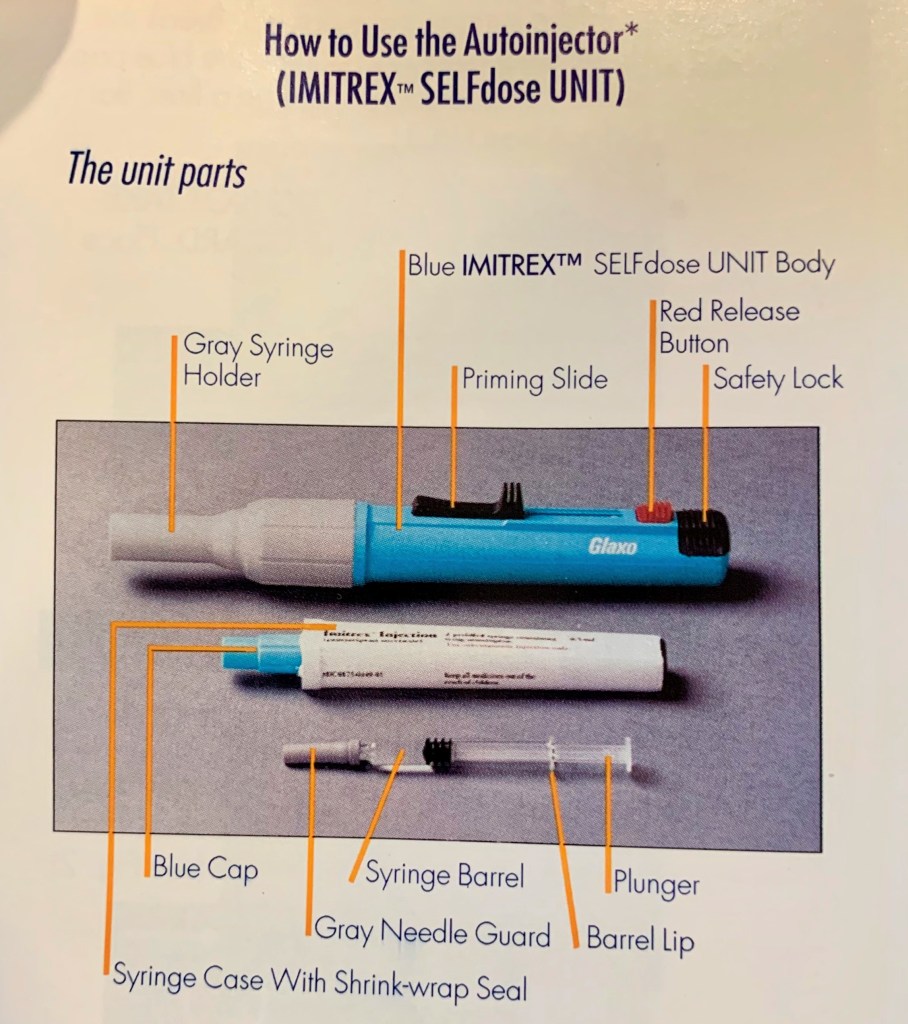
Administration. The drug came in a syringe but also included a bulky injector device modeled after a military field injector. The patient had to disassemble the device, insert the syringe, then rebuild the device. The plan was to load the device pre-migraine, then when migraine struck, the patient would slide off the safety catch, pull off a syringe cover, place the device on their leg or arm and press the firing button. LOTS of opportunity for error.
Cost. A single dose of Imitrex Injection cost about $35 at launch and was sold in packs of 2 syringes.
Side Effects. The activity of many drugs falls under one of two categories: either they mimic the effect of a naturally occurring chemical in the body or they block said effect. ‘Blockers’ or ‘antagonists’ occupy receptor sites and prevent binding. These drugs usually take some time to impart their desired effect. On the other hand, ‘agonists’, drugs that impersonate natural molecules, usually accelerate chemical cascades and tend to have more dramatic impact. Imitrex is a serotonin agonist. Serotonin is a ubiquitous neurotransmitter which has a wide range of effect on many body sites. Now, there are many subtypes of serotonin, each with its own job, but suffice it to say that the response to sumatriptan is rapid and, well, weird. Patients with migraine routinely report that upon injection they feel heavy, pressured, fuzzy, hot, thick-tongued and drained. A tingling sensation often follows, starting low in the body and gradually rising through the neck and head area. Many say that the tingling continues near the top of the head for a minute or two, then dissipates, magically taking with it the pain of the migraine. The complex of these side effects came to be known as “triptan sensations”. Whatever you want to call them, it is true that the Imitrex Injection experience is unique, and many did not enjoy it.
But, man did they enjoy the relief that Imitrex often brought. I have many, many stories but one that I enjoy telling involves a doctor as patient, and interestingly, health care providers suffer a significantly higher incidence of migraine than the general public. My own observation and clinical studies have consistently supported this.
Anyway, a Sales Representative in Evansville, Indiana had set up a dinner speaker program. The speaker was a well-known pain specialist who practiced about an hour from the program. The Sales Rep, Phil, had planned to make the road trip in the speaker’s big RV.  Who knows why? Who knows why Phil did anything he did? We get to the office to meet the speaker and the staff tells us that he is ill and laying down in a darkened patient room. Oh, oh. Looks like a cancelled program. Instead, here he comes ambling down the hall with head down, looking like a geriatric rapper, outfitted in sunglasses and baseball cap. He grunts, tosses the keys to Phil who drives the behemoth RV, with me in the passenger captain seat and the doctor/speaker laying down in the back. During the ride to the program he gives himself a second injection of Imitrex (against clear dosing recommendations not to exceed 1 dose in 24 hours!).
About a half hour later the doc comes up front looking a bit rough but says he feels great. He uses the story of our trip during the program, and many others in the audience also relate their personal and/or patient experiences.
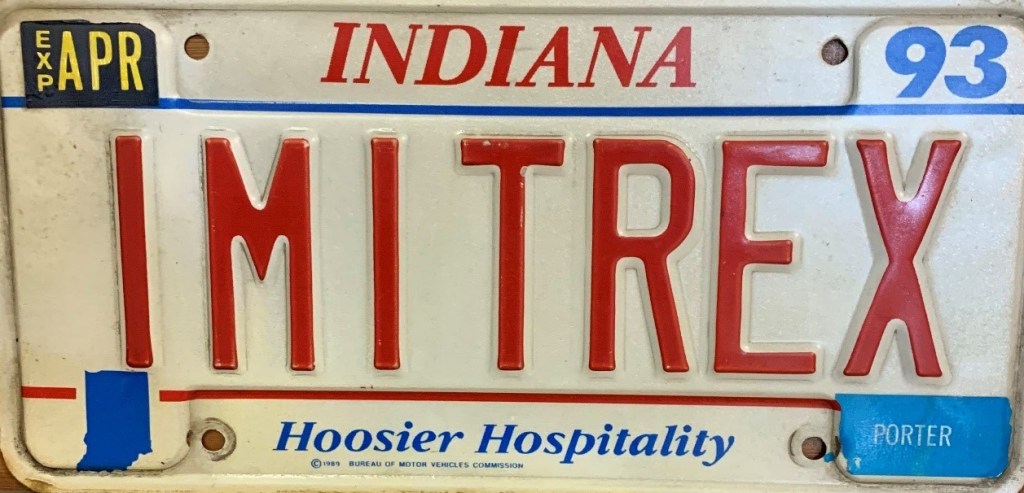
I loved selling Imitrex, my District was exceptional at it, and I decided to say as much on my license plate. By the end of 1993, the launch year for Imitrex Injection, thousands of patients are injecting themselves, and Imitrex sales exceed $150 million dollars.
But then the problems begin…
 Let me be Frank...
Entertaining as always! How are you enjoying life? I am back in CA as a FLL for team Nucala, working for Brian Ferguson. Still with Eric, who will be receiving a saint hood sometime soon 😇
Sent from my iPhone
>
LikeLike
Thanks for bringing back some great memories Frank, I hope you are well and look forward to your next post!
LikeLike
Hey CA. Great to hear from you. Really enjoying retirement and still renovating new home. I’m sure you are happy to be back in CA. Good that you are working with Brian so you can teach him a few things. Be well!
LikeLike
Frank, I hope you are doing well. I love that you are still proud of all the great medicines we have launched. I miss seeing your smiling face!
LikeLike
I know most of the people referenced in your story, Frank. And I count my lucky stars for being fortunate enough to have Imitrex as one of the first drugs I promoted in my pharma career in Indiana (Kokomo territory). It was a real difference maker and remains that way today. Thanks for sharing this!
LikeLike
Frank…I launched Imitrex in Georgia and was also a migraine sufferer who got my life back from that shot!! One of my proudest moments in pharma because I knew how effective it was personally! Great memories and a great company!
LikeLike